Showing posts with label feedstock. Show all posts

Wednesday, February 6, 2013

Linde Engineering Dresden Breathes New Life into Carbo-V Technology


We’ve discussed in previous blog posts how the broad definition of ‘gasification’ covers many diverse processes with different end goals.  These various processes can have different benefits and costs, but the distinction is ultimately at the chemical level. The sophisticated manipulation of the chemical process used in the Carbo-V Technology has particularly held our interest since Linde Engineering Dresden announced it was licensing the technology for use in a Biomass-to-Liquid (BtL) plant last week.

Courtesy: Linde Engineering Dresden; Biomass Energy.
Carbo-V Technolog is described as a multi-stage gasification processes that was originally developed by CHOREN Industries, and acquired by Linde in February 2012 after CHOREN went bankrupt. The subsidiary of The Linde Group announced it was licensing the technology to Finnish Forest BtL for use in a 480 MW plant to be built in Kemi, Northern Finland and is expected to be operational by the end of 2016.

 The Carbo-V Technology claims to have overcome the tar and methane obstacles that frequently prohibit syngas from being used in Fischer-Tropsch applications for the production of synthetic fuel. The multi-stage process appears to use a sophisticated form of partial oxidation while borrowing elements from steam reformation and re-injecting carbon into the gas cleanup cycle.

Feedstocks suitable for the Carbo-V Technology include rice husks, wood chips, lumber and other wood residues. Process heat is used to dry the feedstock to 15 percent water content before passing it through a low-temperature gasifier (400-500 degrees Celsius), where the biomass is thermally broken down into volatile gases and solid bio-coke or char. At the same time, a mixture of O2/CO2 and steam is injected into the chamber.

A drawing of the Carbo-V Process by CHOREN. 
In the next stage, the partially deconstructed biomass is sent through a partial-oxidation combustion chamber that reaches 1400 degrees Celsius to continue breaking down the tar and long chain C-H molecules. The char that has resulted from the first stage is ground to powder and blown into the hot exit gases below the combustion chamber in a chemical endothermal quenching process that reduces the gas temperature almost instantaneously to approximately 900 degrees Celsius. This elimates unnecessary temperature cycling of the char and improves Carbo-V’s cold gas efficiency.

The resulting syngas is fed through a Fischer-Tropsch process to convert the carbon monoxide and hydrogen into hydrocarbons. CHOREN’s white paper says that the syngas may contain small traces of contaminants that could be harmful to sensitive Fischer-Tropsch catalysts and says they do use scrubbers before compressing the syngas for the Fischer-Tropsch reactor they used when producing SunFuel, before declaring bankruptcy in 2011.

BETTER BTU TAKE: The Carbo-V Technology is a unique manipulation of the traditional partial-oxidation process. In this tricky economic environment, companies may falter, but a good technology will ultimately survive and it looks like Linde Engineering Dresden is breathing new life into this technology with its announcement of the licensing agreement with Finnish Forest BtL. Our only concern is that a 480 MW plant will require 1.5 million tons of wood to produce its projected 130,000 tons of biodiesel and naptha. The project is being funded by the European Union’s NER300 for innovative, low-carbon technologies and we’ll continue to monitor the project and bring you updates on our project blog.

Recommended Reading:


Linde Buys CHOREN’s Carbo-V TechnologyRenewables International, The Magazine (Feb. 15, 2012)

Sustainable SunFuel from CHOREN’s Carbo-V Process – By Tom Blades, Matthias Rudloff and Olaf Schulze, CHOREN Industries (Sept. 2005)project blog

Friday, August 10, 2012

Large-Scale EfW Company Covanta Gets on Board with Gasification


For anyone out there who is still skeptical of gasification we offer you this: when one of the world’s largest energy from waste (EfW) companies climbs on board the gasification train, you know the technology is here to stay.

Courtesy: Covanta, REW Mag. 
Covanta Energy, owner and operator of more than 40 EfW facilities in the U.S. and Europe announced plans to commercialize a gasification unit it has been testing at the Covanta WBH site in Tulsa, Okla. The unit has just completed a 10-month test run, processing 350 tons of post-recycled municipal waste per day.

The adoption of gasification technology marks a significant shift in Covanta’s stance on waste to energy. The company, which uses a mass burn process at the majority of its facilities, has previously felt that separation of materials and new technology such as gasification, was unnecessary. Covanta has always been focused on producing the maximum amount of reusable energy from its feedstock and has been quoted as saying the high cost of sorting and recycling didn’t justify the difference it made:

“Within the [waste] hierarchy, the most debated and potentially contentious boundary is that separation of waste for recycling and recovery. It is accurate that as a general rule a high level of separation of waste for recycling is desirable before the residues are diverted towards recovery (generally, energy recovery). However, the costs of segregation and of reprocessing tend to increase significantly as ever higher percentages are achieved while quality, contamination issues, and the additional activities required to achieve the higher percentages often reduce the environmental benefit. Thus the marginal cost-benefits of very high levels of recycling may not be favorable.”
            - Covanta Energy Comments on: National Waste Policy Discussion Paper

Similarly, Covanta had previously said that gasification was unnecessary due to the fact that large-scale EfW plants had developed sophisticated back-end cleanup systems to keep hazardous gases from escaping into the air. The changes in Covanta’s views on gasification signify an ongoing revolution towards cleaner waste-to-energy processes.

Although Better BTU has not been able to find out specifics on Covanta’s gasification system, it appears to be a partial-oxidation technology that heats the MSW to high temperatures to create a syngas. The syngas is then combusted and processed through an energy recovery system followed by an emissions control system. The company has not released the energy value of the syngas.

Covanta headquarters says the successful demonstration will allow the company to market its CLEERGAS (Covanta Low Emissions Energy Recovery Gasification System) to clients interested in the technology. Interestingly enough, the company has not made announcements that it plans to use the technology in any other existing or new facilities and President and CEO Anthony J. Orlando had this to say on the Q2 2012 Results – Earnings Call:

“We believe this technology will enable us to be more competitive on small units and that opens new markets. The level of interest we’ve seen thus far is encouraging and we’re now exploring several opportunities. We believe this technology will be an important part of our long-term growth. But I don’t want to get anybody too excited, I’m talking long-term. Development and implementation of energy from waste projects take years.”

So while it is extremely encouraging to see the EfW giant embracing gasification, it sounds like we still have a ways to go before it replaces the traditional mass burn facility. 

Further Reading:

Covanta Energy Comments On National Waste Discussion Paper – Written by Covanta for the Department of Environment, Community and Local Government (2012).

Covanta's Gasification Technology Ready for Market  - By Shawn Wright, Waste & Recycling News (June 22, 2012).

Covanta Holding's CEO Discusses Q2 2012 Results – Earnings Call Transcript (July 19, 2012). 

Monday, July 2, 2012

ALL Power Labs Makes Big Moves by Starting Small


In 2008, Jim Mason, founder of ALL Power Labs began manufacturing and selling kits for the construction of small-scale downdraft gasifiers. Designed for the thermal conversion enthusiast, his business sought to support “research, education and DIY hacking.”

Four years later, more than 300 Gasifier Experimenter’s Kits (GEK) have been sold with units supplementing research in over 40 universities around the globe. Meanwhile, ALL Power Labs continues to grow in popularity and size as new products reach a larger capacity.

With the GEK, customers have the option of building the gasifier from scratch or purchasing a fully fabricated version that is ready for final assembly. The GEK makes clean gas for power generation or biochar for soil amendment. While the system is meant for smaller engines such as Listers, China Diesels and Briggs, the website shows how it is possible to adjust the nozzle size and position to make it compatible with a four-cylinder engine.
ALL Power Labs Gasification Weekend Workshop
in March 2012. Courtesy: ALL Power Labs. 

The GEK served as an entre into the gasification industry for Mason. As his company and technical knowledge grew, so did the size of its gasifiers. The GEK Power Pallet was launched two years after the first GEK kit as a fully automated downdraft gasifier that converts woody biomass into electricity, heat and PTO shaft power. Using Kubota and GM engines, Mecc Alte AVR gen heads and mounted on a metal pallet, the unit comes in 10kW and 20kW sizes.  ALL Power Labs tailors each unit to the customer’s needs and the onboard computer makes adjustments normally required of a trained operator.

Director of Sales Dusty Swartz says the company has seen a shift in customer demand from the original GEK to the fully automated Power Pallets, which are often used in agricultural communities and third-world countries. He estimates that ALL Power Labs has sold approximately 100 units since it came onto the market in 2010 and says that sales of the original GEK  now make up only 10 percent of sales.

While the company has solidified itself as the dominant force in the small-scale market, it continues to work on increasing the size of its units. Mason and company have just finished installing a 100kW Power Trainer system, housed within a standard shipping container, at the University of Minnesota.

One of All Power Labs’ greatest strengths is its openness and transparency. Stressing that he seeks to build a collaborative society, Mason invites pitch ideas from anyone on anything ranging from feedstock to possible uses and technological tweaks. Additionally, ALL Power Labs holds monthly Open Houses, inviting anyone interested to come and see a demonstration and ask questions of the engineers, sales professionals and other members of the community. Occasional weekend workshops assist in bridging the gap between client and company.

BETTER BTU TAKE: ALL Power Labs is the only company we’ve seen enter the market through home kits and we’re reminded of the hundreds of hobbyists who built computers in garages from Apple kits in the early ‘90s. While Mason still has a long way to go before becoming the next Steve Jobs, we love the idea of starting small a reputation as you learn. While some may discount ALL Power Labs as just a company for gasifier enthusiasts, we’d caution against that. Mason can sidestep obstacles other companies face such as having to raise capital for a project with largely unproven technology. If the company can keep up its momentum it should be a strong competitor with IST’s Gem and GSS Energy’s k500 Mobile Pyrolysis Unit (see previous blog posts).


For more information on the Gasifier Experimenter’s Kit:

Anyone interested in attending the July 13th Open House at ALL Power Labs headquarters in Berkeley, Calif. should contact sales@allpowerlabs.org

Tuesday, May 29, 2012

GSS Energy: Next British Invasion?


Located in Chichester, United Kingdom, GSS Energy is a small startup company that has developed a small pyrolysis unit. Housed in a 40-foot container, the physical specs of the k500 Mobile Pyrolysis Unit may be small, but GSS Energy hopes it will be the biggest thing from Britain since the Beatles. 

Pyrolysis still falls under the umbrella of gasification because it heats up the feedstock to convert it to a gas, which is then burned. Unlike partial oxidation gasifiers, there is no additional air introduced in the pyrolysis process. The procedure isn’t a new one – it’s been around for over 100 years and is widely used in the chemical and petroleum industries, but hasn’t been commonly used for trash disposal. Similar to other gasifiers, the end result of a pyrolysis unit is a syngas that can be used for a variety of things including fueling a boiler and making electricity.
Courtesy: GSS Energy. 

The k500 Mobile Pyrolysis Unit produces a syngas that can be used to create electricity in gas reciprocating engines. The gasifier’s only emissions come from using an external source (i.e. butane) to get the unit to temperature. GSS Energy reports that at a price of $2.3 million pounds, a developer processing 4,200 tons per year should recover his initial investment after approximately three years.

The modular unit can generate roughly 500kW, or ½ MW. Part of the key to its efficiency is a control system, which can be operated remotely, and which is continuously adjusting and measuring different features to ensure maximum efficiency is consistently achieved.

Although there is no demonstration model for the k500, a smaller unit (k150) was built and is currently operating in Dubai. The units, which take only five months to build and are fully operational upon delivery, are built in Thailand and the first k500 should be available by Nov. 2012.

GSS Energy also offers a diesel version of its mobile pyrolysis unit. It comes with an additional catalytic processor, distillate unit and storage tanks to convert the syngas to diesel. Currently there are four of these diesel units in use in Thailand, where the diesel it generates from plastics is being used in garbage trucks.

Better BTU Take: This is the first pyrolysis gasifier we’ve reviewed and we like the idea because it creates a higher-BTU syngas. We love the modular design because it opens up the market to a lot of industrial applications. Of course, none of this means much until we can actually see a k500 unit in operation. GSS Energy reports that the reason it doesn’t have a demonstration unit is because so many people were interested in purchasing right away that there is already a backlog of orders. We’ll keep you updated when the product rolls off the line. 

Tuesday, April 24, 2012

Rentech in Reverse


While most companies in the gasification industry are concentrated on proving the technology and securing commercial contracts, Rentech, Inc. lept ahead to the next step. Setting its sights on the Holy Grail of waste to energy, the company focused on creating synthetic transportation fuel that is clean enough to be used in pipelines and engines.

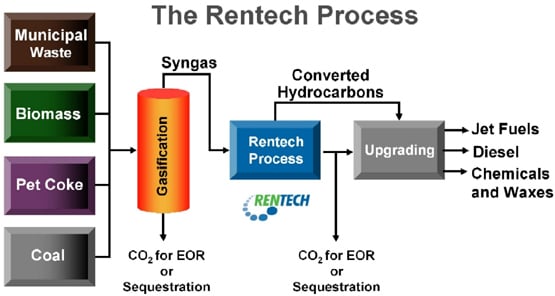
Rentech has developed a patented version of the Fischer-Tropsch process, utilizing components from smaller companies it has acquired over several years. Dubbed the Rentech Process, the company uses one of two gasifiers, a catalyst, reactor and upgrader to convert biomass and waste materials into ultra-clean synthetic fuel and chemicals.

Although the Rentech Process can work with a variety of feedstocks, the company is primarily focused on cellulosic materials. After purchasing SilvaGas, Inc. in 2009, Rentech began offering the Rentech-SilvaGas gasifier. The patented technology was originally developed in collaboration with Battelle Labs and the U.S. Dept. of Energy as part of its Biomass Power Program.  A unit ran for several years in the McNeil Power Station of Burlington, Vt. although web searches haven’t been able to verify if it is still in operation or owned by Rentech.

Rentech also owns the Rentech-ClearFuels gasifier, which has a product demonstration unit in Commerce City, Colo. Using a hydrothermal reformer, the gasifier produces hydrogen in addition to a syngas. According to transcripts of the company’s quarterly earnings call to investors, Rentech purchased SilvaGas and its gasifier because it was further down the path to commercial development than the one it had been developing with ClearFuels.
Courtesy: Rentech, Inc. 

The iron-based catalyst used in the Rentech Process is the most critical component, according to the company. As the only North American-based company using it, the iron-based catalyst is mixed with liquid wax in a slurry bubble column reactor. The syngas is then upgraded to synthetic diesel fuel (RenDiesel) or jet fuel (RenJet) using UOP’s upgrader. The jet fuel produced can be blended with conventional jet fuel for use in military and smaller commercial planes.

While Rentech was initially involved in several projects, the 2011 fourth-quarter earnings call transcript states that they have altered their direction and are backtracking a bit. The company has abandoned proposed projects in Port St. Joe, Fla. and Natchez, Miss. and is trying to find a new outlet for the rights to the 1.3 million tons of timber it purchased from the Province of Ontario.

Better BTU Take: While we applaud Rentech’s initiative, we feel that this is yet another illustration of a company investing in several projects before having a clear idea of what is actually involved in developing a project of this magnitude. With the rate of announced projects exponentially higher than completed projects, each cancelled project lends credibility to detractors from the renewable energy industry that say it doesn’t work.

As every company in this industry has had to overcome both financial and regulatory obstacles, we look forward to seeing where Rentech goes after regrouping. 


Friday, March 23, 2012

Avoid the Pile – Unless You Have Ecoremedy!


Even in the world of waste, feedstock can be classified as “good” and “bad.” Almost everyone can process dry wood chips, but rarely do you find someone offering to take care of cow pies and other animal manure.

If you find yourself in the market for a gasifier and have a smelly sort of feedstock, then Enginuity’s Ecoremedy might be one to consider. The modular system uses patented grating and air distribution systems to process high-moisture content feedstocks that may otherwise be unable to be converted to energy.

Ecoremedy (Courtesy: Enginuity Energy, LLC) 
Unlike other partial oxidation gasifiers on the market, Ecoremedy processes feedstocks with a moisture content of up to 65 percent and/or an ash content exceeding 50 percent without pre-drying. Cutting out this step saves money on the process of gasifying a feedstock you can already get for next to nothing.

Ecoremedy is small and scalable, ranging from 100 kWe to 35 MWe and can process anywhere from 12 to 120 tons per day, depending on moisture content and need.

So why haven’t we seen one on every acre of farmland swallowing up excess chicken manure and allowing us to frolic through the pastures unconcerned with where we land? Ecoremedy produces a low-quality syngas and we suspect it is fairly expensive. Enginuity, an engineering firm located in Mechanicsburg, Pa., has a demonstration model on the campus of Harrisburg Area Community College and invites potential investors to test out the process with their own feedstock, but has not yet been able to land a commercial contract.

Vice President of Operations and International Business Development said it best when he said, “Like everyone else, we have a line of people who want to be number two.”

Enginuity appears to be focusing its efforts on Europe because the cost of electricity is higher and gasification projects are already in existence.

Better BTU Take: This is another example of technology getting smaller and more modular and we love it. It’s a shame that Enginuity has been unable to get a commercialized plant domestically, but we think focusing on Europe is the company’s best bet.