Tuesday, May 29, 2012

GSS Energy: Next British Invasion?


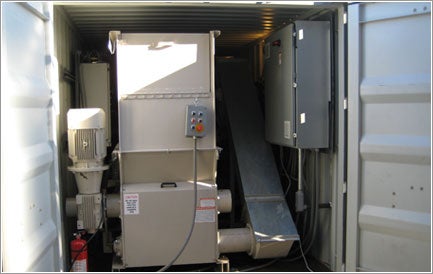
Located in Chichester, United Kingdom, GSS Energy is a small startup company that has developed a small pyrolysis unit. Housed in a 40-foot container, the physical specs of the k500 Mobile Pyrolysis Unit may be small, but GSS Energy hopes it will be the biggest thing from Britain since the Beatles. 

Pyrolysis still falls under the umbrella of gasification because it heats up the feedstock to convert it to a gas, which is then burned. Unlike partial oxidation gasifiers, there is no additional air introduced in the pyrolysis process. The procedure isn’t a new one – it’s been around for over 100 years and is widely used in the chemical and petroleum industries, but hasn’t been commonly used for trash disposal. Similar to other gasifiers, the end result of a pyrolysis unit is a syngas that can be used for a variety of things including fueling a boiler and making electricity.
Courtesy: GSS Energy. 

The k500 Mobile Pyrolysis Unit produces a syngas that can be used to create electricity in gas reciprocating engines. The gasifier’s only emissions come from using an external source (i.e. butane) to get the unit to temperature. GSS Energy reports that at a price of $2.3 million pounds, a developer processing 4,200 tons per year should recover his initial investment after approximately three years.

The modular unit can generate roughly 500kW, or ½ MW. Part of the key to its efficiency is a control system, which can be operated remotely, and which is continuously adjusting and measuring different features to ensure maximum efficiency is consistently achieved.

Although there is no demonstration model for the k500, a smaller unit (k150) was built and is currently operating in Dubai. The units, which take only five months to build and are fully operational upon delivery, are built in Thailand and the first k500 should be available by Nov. 2012.

GSS Energy also offers a diesel version of its mobile pyrolysis unit. It comes with an additional catalytic processor, distillate unit and storage tanks to convert the syngas to diesel. Currently there are four of these diesel units in use in Thailand, where the diesel it generates from plastics is being used in garbage trucks.

Better BTU Take: This is the first pyrolysis gasifier we’ve reviewed and we like the idea because it creates a higher-BTU syngas. We love the modular design because it opens up the market to a lot of industrial applications. Of course, none of this means much until we can actually see a k500 unit in operation. GSS Energy reports that the reason it doesn’t have a demonstration unit is because so many people were interested in purchasing right away that there is already a backlog of orders. We’ll keep you updated when the product rolls off the line. 

Tuesday, April 24, 2012

Rentech in Reverse


While most companies in the gasification industry are concentrated on proving the technology and securing commercial contracts, Rentech, Inc. lept ahead to the next step. Setting its sights on the Holy Grail of waste to energy, the company focused on creating synthetic transportation fuel that is clean enough to be used in pipelines and engines.

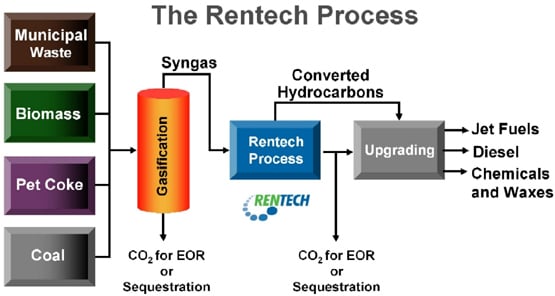
Rentech has developed a patented version of the Fischer-Tropsch process, utilizing components from smaller companies it has acquired over several years. Dubbed the Rentech Process, the company uses one of two gasifiers, a catalyst, reactor and upgrader to convert biomass and waste materials into ultra-clean synthetic fuel and chemicals.

Although the Rentech Process can work with a variety of feedstocks, the company is primarily focused on cellulosic materials. After purchasing SilvaGas, Inc. in 2009, Rentech began offering the Rentech-SilvaGas gasifier. The patented technology was originally developed in collaboration with Battelle Labs and the U.S. Dept. of Energy as part of its Biomass Power Program.  A unit ran for several years in the McNeil Power Station of Burlington, Vt. although web searches haven’t been able to verify if it is still in operation or owned by Rentech.

Rentech also owns the Rentech-ClearFuels gasifier, which has a product demonstration unit in Commerce City, Colo. Using a hydrothermal reformer, the gasifier produces hydrogen in addition to a syngas. According to transcripts of the company’s quarterly earnings call to investors, Rentech purchased SilvaGas and its gasifier because it was further down the path to commercial development than the one it had been developing with ClearFuels.
Courtesy: Rentech, Inc. 

The iron-based catalyst used in the Rentech Process is the most critical component, according to the company. As the only North American-based company using it, the iron-based catalyst is mixed with liquid wax in a slurry bubble column reactor. The syngas is then upgraded to synthetic diesel fuel (RenDiesel) or jet fuel (RenJet) using UOP’s upgrader. The jet fuel produced can be blended with conventional jet fuel for use in military and smaller commercial planes.

While Rentech was initially involved in several projects, the 2011 fourth-quarter earnings call transcript states that they have altered their direction and are backtracking a bit. The company has abandoned proposed projects in Port St. Joe, Fla. and Natchez, Miss. and is trying to find a new outlet for the rights to the 1.3 million tons of timber it purchased from the Province of Ontario.

Better BTU Take: While we applaud Rentech’s initiative, we feel that this is yet another illustration of a company investing in several projects before having a clear idea of what is actually involved in developing a project of this magnitude. With the rate of announced projects exponentially higher than completed projects, each cancelled project lends credibility to detractors from the renewable energy industry that say it doesn’t work.

As every company in this industry has had to overcome both financial and regulatory obstacles, we look forward to seeing where Rentech goes after regrouping. 


Friday, March 23, 2012

Avoid the Pile – Unless You Have Ecoremedy!


Even in the world of waste, feedstock can be classified as “good” and “bad.” Almost everyone can process dry wood chips, but rarely do you find someone offering to take care of cow pies and other animal manure.

If you find yourself in the market for a gasifier and have a smelly sort of feedstock, then Enginuity’s Ecoremedy might be one to consider. The modular system uses patented grating and air distribution systems to process high-moisture content feedstocks that may otherwise be unable to be converted to energy.

Ecoremedy (Courtesy: Enginuity Energy, LLC) 
Unlike other partial oxidation gasifiers on the market, Ecoremedy processes feedstocks with a moisture content of up to 65 percent and/or an ash content exceeding 50 percent without pre-drying. Cutting out this step saves money on the process of gasifying a feedstock you can already get for next to nothing.

Ecoremedy is small and scalable, ranging from 100 kWe to 35 MWe and can process anywhere from 12 to 120 tons per day, depending on moisture content and need.

So why haven’t we seen one on every acre of farmland swallowing up excess chicken manure and allowing us to frolic through the pastures unconcerned with where we land? Ecoremedy produces a low-quality syngas and we suspect it is fairly expensive. Enginuity, an engineering firm located in Mechanicsburg, Pa., has a demonstration model on the campus of Harrisburg Area Community College and invites potential investors to test out the process with their own feedstock, but has not yet been able to land a commercial contract.

Vice President of Operations and International Business Development said it best when he said, “Like everyone else, we have a line of people who want to be number two.”

Enginuity appears to be focusing its efforts on Europe because the cost of electricity is higher and gasification projects are already in existence.

Better BTU Take: This is another example of technology getting smaller and more modular and we love it. It’s a shame that Enginuity has been unable to get a commercialized plant domestically, but we think focusing on Europe is the company’s best bet.  


Thursday, March 1, 2012

IST Energy – Finding Its Niche


There is a business philosophy that says you should do one thing and do it well. Find your niche, specialize in something and establish yourself.
IST Energy's GEM is modular, making for easy
transportation. Courtesy: Entrepreneur Magazine.

That’s exactly what IST Energy is doing. The Waltham, Mass.-based company has developed its Green Energy Machine (GEM), a “container-sized waste-to-energy conversion system” and is currently working on getting its first project installed at Edwards Air Force Base in California.

What makes the GEM a perfect fit for the military is its small size and modular shape, making it easy to deploy to bases overseas. The system takes paper, plastic, food and agricultural waste and shreds it before sucking out the moisture to create dense pellets. The pellets are then fed into a downdraft gasifier which yields a low-BTU syngas (approximately 180 BTU/SCF) that can be used in an electric boiler or generator.

While the flagship project was originally scheduled to be up and working in early 2011, the project has been stalled by permitting obstacles. The company made progress in December and hopes to be commencing demo activities soon.

Better BTU Take: With a price tage of $1.1million and an electrical output of 72 kWe, the GEM is still fairly expensive for the private sector. IST Energy has been smart by targeting the military, where the price of the electricity isn’t as important as the availability of it in remote locations. 


Monday, January 30, 2012

On the Right Track: Sierra Energy Gets Smaller

Mike Hart, President and CEO Sierra Energy
Sometimes the best innovations come from trying to solve a different problem. After all, Post-It notes, microwaves and potato chips were all invented by accident. Sierra Energy, founded in 2004 in Davis, Calif., evolved in a similar fashion.

Bruce Claflin, the chief industrial engineer at Kaiser Steel and John Jasbinsek, initially developed Sierra’s technology. The duo was originally working on a way to produce iron more efficiently before coming to the realization that they had created an even better way of converting waste streams into energy.

Sierra Energy is owned by Sierra Railroad, which runs three scenic lines throughout Northern California. The parent company gives Sierra Energy the solid financial backing every new technology needs to get up and running. Railroads produce waste in the form of ties and could be the reason Sierra Railroad was so interested in furthering a clean and efficient gasification system.

The technology derives from the traditional blast furnace found in steel mills. By modifying the design to inject steam and oxygen into the system, Sierra’s FastOx gasifier creates a medium-BTU syngas capable of producing renewable energy. The company mentions it’s goal of retrofitting blast furnaces, which we view as an intelligent idea since having some of the infrastructure in place will save $$.

Sierra Energy has a demonstration system in place at the Department of Defense’s Renewable Energy Testing Center at McClellan Park, Calif. Known as the Mk4 Gasifier, it operates at a 5 ton-per-day rate, which is smaller than the 10 tpd FastOx Pathfinder the company plans to develop for commercial purposes. The price tag for the six containerized modular system is listed as $2.7 million.

Better BTU Take: We’ve long said that a smaller and more modular design is the best chance our industry has for development and it looks like Sierra Energy is on the same wavelength. We’ve yet to see numbers on the output of the demonstration model which leaves the question of its profitability but we’ll definitely be on the lookout for updates on this technology.


Monday, January 16, 2012

Thermoselect: A Big System for a Small Island


A Thermoselect high-temperature chamber.
Photo courtesy: Interstate Waste Treatment.
Apple CEO Steve Jobs revolutionized the computer industry when he took computers that once needed the space of an entire room and reduced them to fit into the palm of our hand. The smaller is better trend has infiltrated most areas of technology and renewable energy is no exception. Which begs the question, what happened to the mainframes?

Thermoselect designs large-scale partial-oxidation gasifiers. There are several plants in operation across Japan including Chiba, Mutsu, Osaka, Tokushima, Kurashiki and Nagasaki. Thermoselect is able to use MSW and industrial waste without sorting out metals and other recyclables and produces a low-BTU syngas that is exported and used in boilers and gas engines.

While the Japanese company appears to have done very well for itself in the Pacific Rim, licensees in Europe and America haven’t been as successful. A plant in Karlsruhe, Germany shut down in 2004 after five years and the initial plant in Fondotoce, Italy was also closed in the late ‘90s. Interstate Waste Management, based in Malvern, Pa., has been working on developing a commercial plant in the United States for several years but also hasn’t yet been successful.

So why has Thermoselect worked in Japan and not elsewhere? It’s hard to say but Better BTU thinks cost is a substantial part of the issue. Our information is that equipment costs run well above $5,000 per installed kW. With Japan being an island, landfills are limited and tipping fees are high. That coupled with high electricity costs make the system more economical in the Land of the Rising Sun than it might be elsewhere.

Better BTU Take: Thermoselect rushed onto the scene with facilities cropping up all over in the late 90’s but today only the plants in Japan remain. The massive cost associated with these systems may lead Thermoselect the way of the computer mainframe.
Thermoselect's Facility in Chiba, Japan.
Courtesy of Thermoselect.

For more on Thermoselect, visit http://www.thermoselect.com


For information on Interstate Waste Treatment, a Thermoselect licensee in the United States, visit http://www.iwtonline.com

Wednesday, December 21, 2011

Finding Funding: Plasco's Biggest Supporter

In an industry where finding funding for projects can feel a little like looking for a needle in a haystack, Candian energy company Plasco has an edge over the competition.

Plasco uses plasma gasification to convert MSW to energy. Plasma differs from the traditional partial oxidation process by using a plasma torch to heat the chamber to 5,000-10,000 degrees Fahrenheit. As a result, the MSW is vaporized rather than slowly combusted, as in typical partial-oxidation processes.

Plasma gasification is thought to be among the cleanest technologies on the market. The downside is that its expense eliminates it as an option for developers struggling to get financed. Luckily for Plasco, funds are one thing it doesn’t have to worry too much about, thanks in large part to financier George Soros.

Wealthy financer George Soros at the World
Economic Meeting in 2010. 
The Hungarian-American business magnate led a deal with private investors that gave Plasco a $140-million windfall in March 2011. This is the second big payday for Plasco, which totaled $110 million from investors the previous year.

“The performance of the company’s existing Ottawa plant and a strong pipeline of contract opportunities have allowed us to demonstrate to investors that our technology is proven and ready for commercial delivery,” Plasco CEO Rod Bryden said in a press release issued by the company in March.

Soros’ involvement undoubtedly gives Plasco more than just a comfortable financial backing. The support of such a well-known and savvy investor gives credibility in a market where companies are scrambling to prove why its technology is the best. The company already has one facility operating for commercial use in Ottawa and is currently working on a proposal to build a waste conversion facility in Salinas Valley, Calif.

Better BTU’s Take: We love the technology, but don’t love the cost. If it can become cost-effective as more plants get built, it could become a real contender in the large-system market. We’re also going to be keeping an eye on the announcement-to-close ratio: companies that announce a lot of projects but aren’t able to get them across the finish line only hurt the industry.

Wednesday, December 14, 2011

Fluidized Bed Boilers: Ol’ Reliable

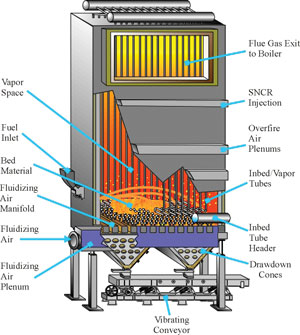
EPI Fluidized Bed Boiler. Courtesy: Canadian
Biomass Magazine
In a time where the industry is buzzing with the different breeds of gasifiers, some are ready to declare older technologies, such as fluidized bed boilers, as obsolete. But before you begin designing a massive castle with all that extra sand, we’d like to examine the pros and cons of fluidized beds.

Energy Products of Idaho has built a strong foundation since producing North America’s first biomass fluidized bed in 1973. The company now boasts more than 100 installations worldwide, most recently working on two large renewable energy projects in Oregon.

EPI’s systems range from over air-blown installations, which work similarly to incinerators, to gasification through a partially-oxidized staged combustion system. The strength of its systems is the thermal flywheel, which creates efficient combustion by keeping the temperature regulated to create a stable flow of uniform gas quality.

With 38 years of experience and a proven design, EPI is the Ol’ Reliable of the renewable energy industry. It’s like the 1970s Fords that keep on rolling while some of the newer models run into a new glitch every other week.

The problem is that the high cost keeps many projects just out of reach for struggling developers. The industry badly needs a proven, low-cost entry point design to further market development. EPI could have a hard time competing with newer gasifiers once the technology is proven because they can offer attractive price points.

Although EPI does actually offer gasifiers as part of its services, the fluidized bed is its stronghold and the company believes firmly in it. Whether that will change with the tides of time remains to be seen, but we feel they have the talent to create a new age gasifier if that becomes a goal of theirs down the line.

Better BTU’s Take: Developers struggling to get newer technologies financed should definitely take a look at using an EPI fluidized bed. It may not win the battle in the long run but it’s probably the best bet for your money right now.

Tuesday, December 6, 2011

Waste Conversion Congress on the West Coast

The Better BTU boarded a plane headed west on Monday, headed for San Jose, Calif. and the Waste Conversion Congress. Taking place at the Convention Plaza Hotel and billed as a "thought leadership conference and an unbiased forum" we are excited to hear from experts in our rapidly growing field.

But don't miss us too much! We're tweeting live from the conference and will be posting reports and our thoughts on what we're learning twice a day on a blog we set up specifically for the occasion! 

Follow us on Twitter @BetterBTU and sign up for our blog updates to be sent straight to your email at http://thebetterbtu.blogspot.com.

Friday, December 2, 2011

Strong Company, Simple Design

PHOTO: ICM, Inc.
Leonardo da Vinci said “Simplicity is the ultimate sophistication.”

That may well be the new motto for ICM as it seeks to expand into the biomass business using partial oxidation gasifiers. The Colwich, Kan.-based company established itself through the design, construction and support of ethanol plants, now boasting over 100 successful installations.

Founded in 1995 by President and CEO Dave Vander Griend, ICM exploded onto the scene with the rise of popularity in ethanol. Looking for a way to lower emissions, Vander Griend started exploring the possibility of constructing their own gasifiers.

The company has been testing a commercial-scale demonstration model in Harvey County since 2009 and reports that it has successfully produced more than 7,000 tons of 13 different feedstocks. The biomass gasifier will be available in three different sizes ranging from 150-450 tons per day.

As with all companies, the challenge becomes finding that first buyer. ICM has chosen to keep its model simple and straightforward, developing a low-BTU syngas that is suitable for burning in a boiler. Its technology won’t appeal to everyone, but for those with a large project looking for a low-BTU syngas, ICM should fit like a glove.

While the company’s established reputation should help to soothe potential investor’s nerves, a decision to purchase any type of gasifier is a costly one. Investors want to see rock-solid feedstock, engineering, procurement and construction, as well as off-take agreements.

Better BTU Take: ICM’s established nature makes it a clear frontrunner among “partial oxidation” gasifiers.